Do Medical Assistants Draw Blood? [Complete guide]
Apr 01, 2026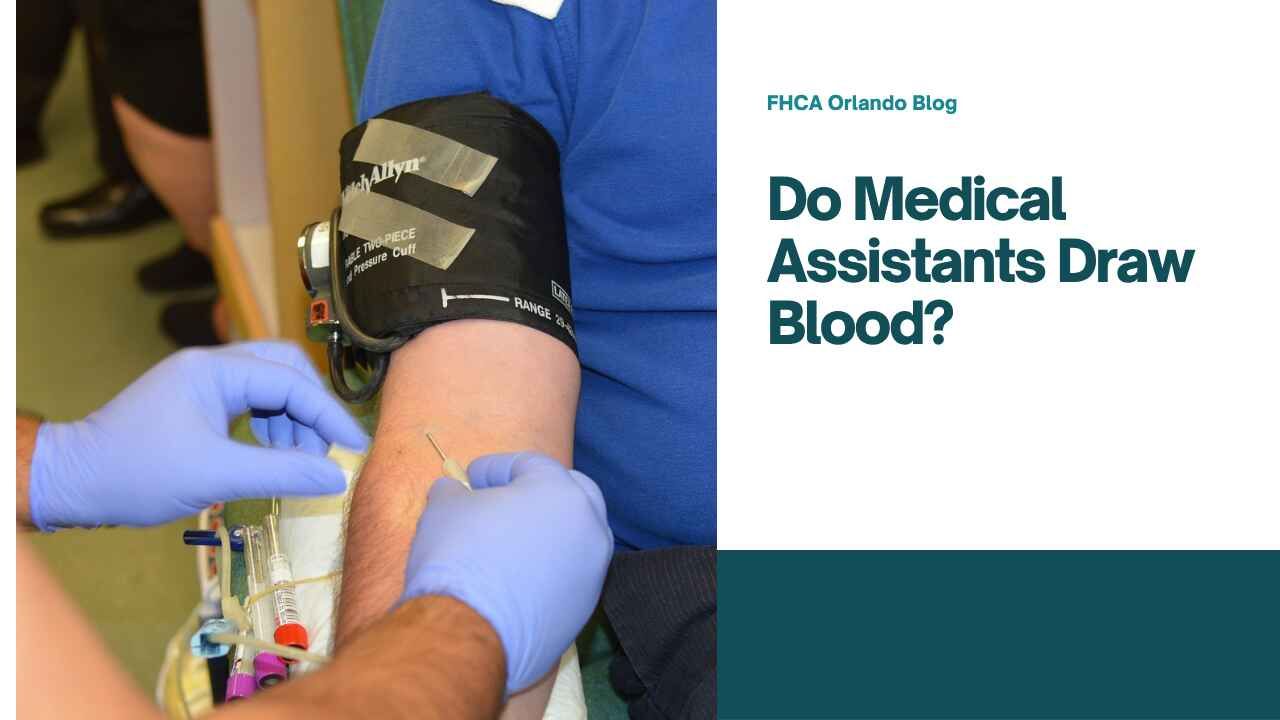
Drawing blood is one of the most common and important processes in the medical care field. Of course, special training is required to do so safely and legally.
Among the possible career options in medicine, you can become a medical assistant. If you’re interested in learning more about medical assistants, or even in becoming one, this guide explains what a medical assistant’s role and responsibilities are regarding blood draw.
Can Medical Assistants Draw Blood Safely and Legally?
Yes, medical assistants can draw blood safely and legally. On one hand, medical assistants are thoroughly trained to perform clinical tasks safely; that includes training in phlebotomy, i.e., blood draw.
Then, while not required in every state, credentials, like the Certified Clinical Medical Assistant (CCMA), provide medical assistants with certification to draw blood. This type of certification is not required by law in the state of Florida, but we highly encourage any aspiring medical assistant to acquire it.
Learning how to properly take blood samples and then getting certified allows medical assistants to work directly with patients, where drawing blood for testing is a standard and expected responsibility.
Do Medical Assistants practice Phlebotomy in Real Clinical Settings?
Of course, medical assistants regularly practice phlebotomy in real clinical settings. These clinical settings typically include hospitals, outpatient clinics, diagnostic laboratories, urgent care centers, and mobile healthcare units. However, medical assistants always act under the supervision of a licensed physician.
At FHCA, our Medical Career Training Programs and Continuing Education Units (CEUs) are designed to provide you with hands-on training where you will practice drawing blood from real people under expert supervision.
Additionally, you will learn how to educate patients on the blood drawing process, offer reassurance and advice regarding healthy blood levels to patients, handle samples appropriately, and maintain lab equipment.
Medical Assistant Duties: Where Phlebotomy Fits In
Phlebotomy is considered a core clinical responsibility and is part of the routine of any medical assistant. When performing a blood draw, three main aspects are into play: patient care, clinical expertise and sample handling.
First, the medical assistant must educate patients about the blood draw process, provide comfort and reassurance before and during the procedure, and offer post-draw advice.
Then, during the procedure itself, they are responsible for safely executing venipunctures and capillary draws, adhering to strict infection control and personal protective equipment (PPE) control, and maintaining lab equipment.
Lastly, after the draw, the sample must be handled properly. This includes proper labeling and storing.
Do Medical Assistants Draw Blood in Florida? What State Law Says
The short answer is no. Certification is not legally required by the state of Florida. However, employers increasingly prefer certified medical assistants to ensure a higher standard of patient care.
There is a difference between legal requirements and employer expectations, and understanding that gap is essential before starting your training.
On one hand, Florida law does not mandate certification, but many employers strongly prefer, and sometimes require, medical assistants to hold a nationally required credential.
Given that medical assistants are not licensed professionals in Florida, they typically work under the supervision of licensed physicians. The state allows physicians to delegate certain clinical and administrative tasks to medical assistants as long as those tasks are performed under proper supervision.
In other words, employers in Florida are responsible for ensuring that their medical assistants are competent to perform their tasks. However, just because certification isn’t legally required doesn’t mean it isn’t an important part of your career as a medical assistant.
Can Medical Assistants Draw Blood in Florida Without Certification?
Medical assistants can draw blood in Florida without being certified. This is because, according to Florida law, certification is not legally required for medical assistants to perform their duties; that includes drawing blood.
Of course, this is as long as they are working under the direct supervision of a licensed physician and have received the appropriate training (which can sometimes even be on-the-job training provided by the employer).
However, it is important to consider that, while it is legally permissible for medical assistants to draw blood without being certified, employers strongly prefer or outright require their medical assistants to hold a national certification, like the CCMA, CMA or RMA, to verify their clinical competency, reduce liability and ensure patient safety.
Can a Certified Medical Assistant Draw Blood More Independently?
No, obtaining a certification does not grant a medical assistant the legal authority to draw blood more independently.
This is because, while certification validates a medical assistant’s clinical skills and makes them more competitive for employment, they still have to work under the supervision of a licensed physician.
In particular, this means that a medical assistant cannot practice independently, which includes drawing blood, without an order and the proper supervision.
Medical Assistant Training: How You Learn Phlebotomy Skills
As one of the main skills of a medical assistant and a routine medical process, the blood draw process is taught as part of our medical assistant program.
Our Medical Career Training Programs and CEUs equip you with all the necessary skills you need to support the entire healthcare team under different scenarios and settings.
Based on both theory and practice, our Medical Assistant Training Program consists of several modules that will teach you all you need to know to draw blood safely and effectively. In our Training Programs, your learning experience will be shaped via a combination of necessary theory and hands-on experience.
The best part is that our programs are designed for beginners, so you don’t need prior experience. Additionally, you will receive support from knowledgeable instructors who will guide you through the whole process.
Medical Assistant Programs in Orlando: Where to Get Hands-On Training
In our Medical Assistant Training Program, you will receive several courses that cover everything you need to know to start your career as a medical assistant.
Of course, all of this knowledge is based on theory, which is then reinforced by training in simulated and supervised settings, designed to provide you with irreplaceable hands-on experience.
In addition, we also offer flexible payment plans and offer different class schedule options. This way, we can help you tailor your learning process to your personal needs.
Do you have any questions? Contact us today to learn more about our Medical Assistant Training Program and start your new career today!